Push a Compass task to a ConnectWise ticket
Create ConnectWise tickets from one or several active Compass tasks, see what the technician gets, and recover from a failed push.
Written By The Lemhi Product Team
Last updated 1 day ago
For vCIOs and account managers. When you finish, a Compass task has a ConnectWise ticket in your technicians' queue and shows its ticket number.
Anyone on your team with the Admin or Member role who has Compass access can push, link, and unlink tickets. Only active tasks can be pushed. Completed, ignored, and removed tasks cannot.
Push one task
In a client's Compass > Tasks, open the task.
Select Push to ConnectWise.
Under Send to, choose where the ticket goes:
Service board (the default). Creates a service ticket on a board. Review the Service board (prefilled with your default; change it for this ticket if you need to).
Project. Creates a project ticket under a phase. Choose a Project (the open projects of the client's mapped ConnectWise company), then a Phase. Both are required.
Review the preview of the ticket. The ticket files under the client's mapped ConnectWise company.
Select Create ticket. With Project, it stays disabled until you choose both a project and a phase.
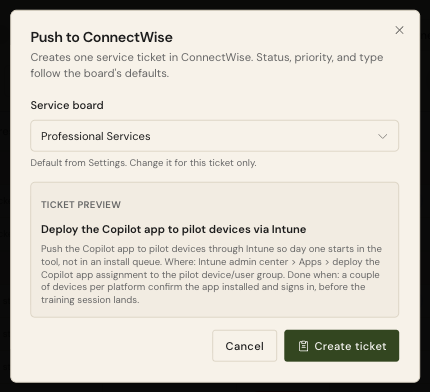
If the client has no open projects, the picker says "No open projects for {company} in ConnectWise." If the project you choose has no phases, it says "This project has no phases in ConnectWise." Lemhi never creates projects or phases; add them in ConnectWise first. If Project is disabled with "Project tickets need Project permissions on the API member. Service tickets still work.", an admin needs to add the Project rows to the security role.
Check: A message confirms the ticket was created, and the task shows a ticket chip with its ConnectWise ticket number, for example CW #12345.
Push several tasks at once
On the Tasks list (Active tab), select between two and 50 tasks.
Select Push to ConnectWise in the action bar.
Under How to create, choose:
One ticket per task (the default). Each task becomes its own ticket.
One ticket for all selected tasks. One ticket covers the whole set. Lemhi prefills a Ticket summary with the client name and task count, plus the playbook or phase name when every task shares one, for example "Rollout & Adoption for Basalt Bear Ltd. (3 tasks)". You can edit it. This suits a batch of small changes a technician can clear in one sitting.
Under Send to, choose Service board and pick a board, or choose Project and pick a project and phase. Your choice applies to every ticket in the set, with either way of creating tickets.
Select Create N tickets or Create 1 ticket.
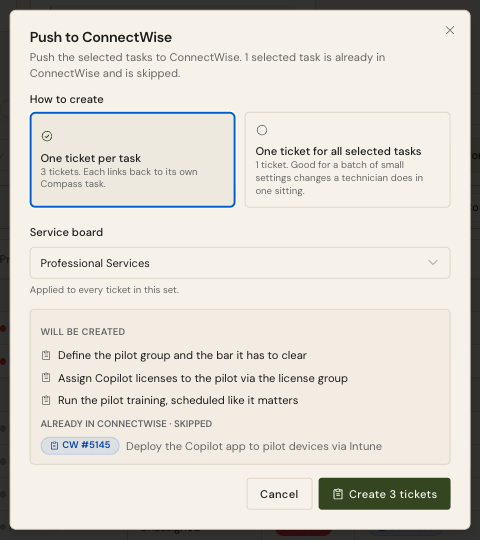
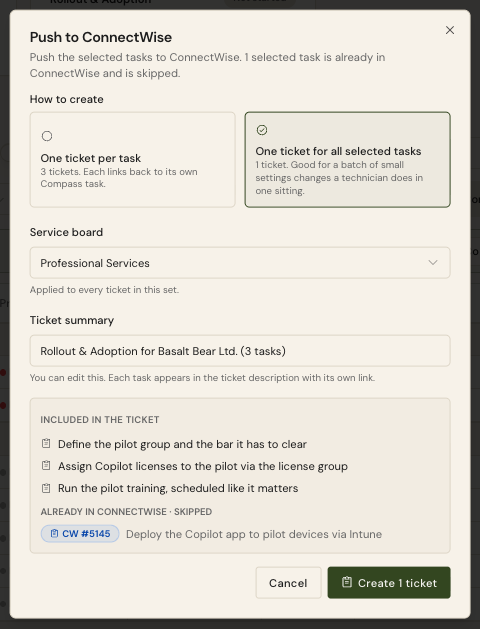
Check: Each task shows its ticket chip. With one combined ticket, every task shows the same ticket number, and each task's detail names the other tasks the ticket covers.
Tasks already in ConnectWise are listed as Already in ConnectWise · Skipped, so a bulk push never creates a duplicate.
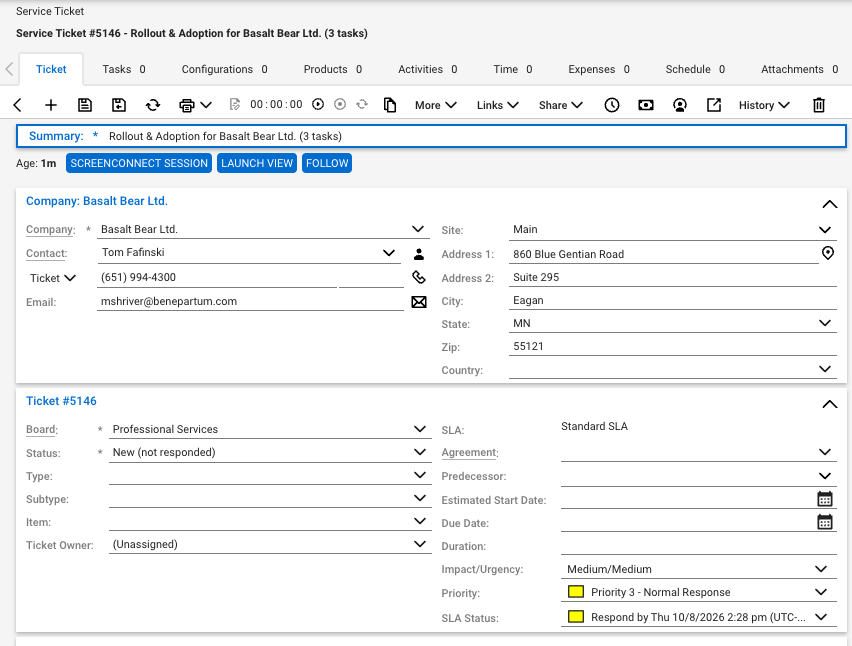
What the technician sees on the ticket
ConnectWise shows its own default Source on the ticket, because Lemhi leaves source unset. ConnectWise may also fill in the company's default contact.
When a push fails
The task shows Push failed with the reason, and nothing else on the task changes.
Select Retry first. Retry checks ConnectWise for a ticket this push may already have created and uses it if it finds one. You can also retry from the row in the task list.
Select Discard only when the reason starts with "ConnectWise rejected the ticket". That means ConnectWise refused the ticket and nothing was created. Then push again to a different board, or link an existing ticket.
Do not discard after a timeout or an unexpected error. ConnectWise may have created the ticket even though Lemhi never got the reply. Discard does not check ConnectWise, so pushing the task again can create a duplicate ticket.
For the exact message you see, find it in ConnectWise errors and fixes.
Related
Was this helpful?
Still need help? Ask the team